Skilled Nursing, Long-Term Care & Short-Stay Rehabilitation at Buck Creek
You may have heard healthcare providers use terms like Skilled Nursing, Long-Term Care (LTC), and Short-Term Rehab when talking about care options for a loved one or a client. These terms can be confusing when you’re new to the world of Skilled Nursing.
At The Healthcare Center at Buck Creek, we’re here to guide you every step of the way. We’ve provided this guide to help you understand the care paths available, the difference between them, what to expect, and answers to common questions. Of course, our caring team is always here to talk to you directly to answer individual questions.
What Is Skilled Nursing?
Skilled Nursing is a broad term that describes short-term or long-term care in a Skilled Nursing Facility, or SNF, provided by licensed nurses and a professional healthcare team. It includes:
“Nursing home” is a common term many people use when they mean “Skilled Nursing Center.” However, “nursing home” is not an industry term, and not all nursing homes are Skilled Nursing Centers. Someone referring to a nursing home could be thinking of an assisted living facility, group home, or even a hospital. Since it means different things to different people, you’ll want to specify whether a nursing home is an SNF.
Buck Creek is a 198-bed Skilled Nursing Center in Alabaster, Alabama. We provide 24-hour Skilled Nursing care, including advanced care for complex medical needs, such as PICC line management, tracheostomy care, and advanced wound care.

Long-Term Care: Ongoing Support in a Skilled Nursing Setting
Long-Term Care is ongoing support for someone who needs daily care indefinitely. The care offered in assisted living facilities and group homes may be considered Long-Term Care in some circles, even though it is not Skilled Nursing. Long-term Senior Care in these places may include assistance with daily activities like bathing and dressing, daily meals, social activities, and Memory Care.In Skilled Nursing, Long-Term Care services include daily assistance with these needs plus medical care in a residential Skilled Nursing Center, such as:
This is what many families think of when they think of nursing homes.
Long-Term Care at Buck Creek is more than just a place to receive healthcare. It’s a place to belong. We promote healing, independence, and a better quality of life in a compassionate, stable environment. We also offer Memory Care in our secure unit with the same compassion. We’ll be with you and your loved one through every step of your journey. And when the time comes, we also partner with local hospice agencies to provide comfort care.
Short-Stay Rehabilitation: Recovery After Illness, Injury, Surgery, or Hospitalization
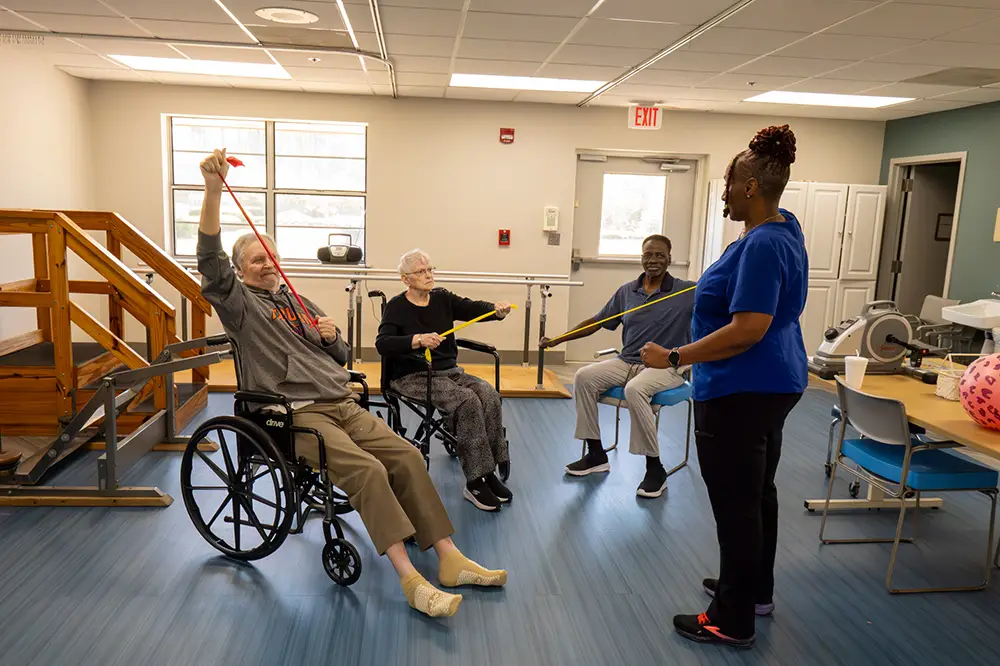
Short-Stay Rehabilitation is goal-focused care in a residential Skilled Nursing Center, with a focus on recovery. It is often appropriate after a qualifying hospital stay when a person is medically stable but not yet ready to return home safely. Unlike Long-Term Care, Short-Stay Rehabilitation starts with a target discharge date and treatment goals. The original date can be adjusted according to progress.
While in a Senior Rehabilitation center, your loved one or client will receive support for activities of daily living plus therapy to restore independence. Common focus areas include mobility, strength, swallowing, communication, and daily living skills.
Your loved one’s therapy needs don’t take a day off, and neither do we. Not all Senior Rehab centers offer therapy seven days a week, but we do. That’s just one way we work hard to help your loved one get back to doing what they love as soon as possible.
Skilled Nursing vs. Rehab vs. Long-Term Care: What’s the Difference?
Short-Stay Rehabilitation and Long-Term Care are the primary two care paths available under the umbrella of Skilled Nursing. Here’s a quick look at the most important differences between the two.
This is what many families think of when they think of nursing homes.

| Short-Stay Rehabilitation | Long-Term Care | |
|---|---|---|
| What Is the Purpose of Skilled Nursing? | To assist with recovery, usually after a qualifying hospitalization | Ongoing daily support, safety, and nursing oversight for those who need continuous care |
| What Qualifies a Patient for Skilled Nursing Care? | Hospital stay, short-term support and therapy needs with an expected recovery outcome | Physician certification of medical necessity and at least two support services needed as defined by law |
| How Long Can You Stay in Skilled Nursing? | Short-term, based on progress and insurance coverage | Long-term, often indefinite |
| Who Pays for Skilled Nursing? | Medicare, Medicare Advantage, Medicaid for qualified guests, private insurance, or private pay* | Medicaid for qualified residents, long-term care insurance, private pay* |
*Coverage and payment options vary. It’s important to understand your coverage before finalizing care decisions. Our admissions team can help your family understand current payment options, including private pay availability.
How Medicare and Insurance May Affect a Rehab Stay
Original Medicare (Part A) offers coverage for post-acute Senior Rehab if all conditions are met, but with limits. Your loved one or client must have had a qualifying hospitalization within the last 30 days. A qualifying hospitalization is an inpatient hospital stay that lasts at least three days in a row. The date of admission counts toward the three days, but the discharge date does not. Time in the emergency room also doesn’t count.
Once Medicare authorizes Rehab, it covers up to 100 days, with no copays for the first 20 days. Supplemental insurance may cover any copays due after the first 20 days. If your loved one has a Medicare Advantage plan, coverage rules and costs may be different. Some Advantage plans waive the three-day hospitalization requirement. If your client or loved one has Medicaid, Medicaid may cover the copays that begin on day 21 and provide additional coverage beyond the 100 days.
Advanced Clinical Capabilities at Buck Creek

Not all Skilled Nursing Centers can provide complex medical care. At Buck Creek, our experienced clinical team provides coordinated care to Long-Term Care residents and Short-Stay Rehab Guests, including those with complex medical needs.
Whether your loved one needs Long-Term Care or Short-Term Post-Acute Care, we can provide:
For families and hospital partners, the right next step often depends on whether a center can safely manage a person’s medical needs while also supporting recovery, comfort, and quality of life.
Which Care Option May Be Right for Your Loved One?
If your loved one needs temporary treatment to return home safely or restore functioning, Short-Stay Rehab is the care path that can help. Short-Stay Rehab may be the right choice if your loved one needs:
If, on the other hand, your loved one’s needs are longer-lasting, Long-Term Care is likely a better option. For example, if your loved one has a chronic condition that requires medical monitoring and nursing oversight, Long-Term Care can support those needs. If they need daily assistance with tasks like bathing, dressing, or toileting, they might benefit from Long-Term Care. If your loved one needs ongoing support for memory loss in a safe setting, Memory Care can provide uplifting care in a secure environment.
You count too. If you need time for yourself to travel, manage other responsibilities, or just take a well-deserved break, Respite Care provides a safe place for your loved one to stay, where they can receive the care they need until you return.
Our admissions team can walk you through all the options and help you find the level of care that’s right for your loved one.
Questions to Ask Before Choosing a Skilled Nursing Center
When choosing a Skilled Nursing Center, you are the best advocate your loved one or client has. Always speak with someone on the admissions team before finalizing the decision.
Here are some important questions to ask:
Skilled Nursing FAQs
Compassionate Skilled Nursing and Rehabilitation in Alabaster, Alabama
The Healthcare Center at Buck Creek is a Skilled Nursing Center where every individual is treated like family. Our mission is to improve every life we touch by providing exceptional healthcare and exceeding expectations.
We provide Short-Term Rehabilitation, Long-Term Care, Memory Care, Respite Care, and hospice-supported services. Our compassionate interdisciplinary team provides coordinated care with the ability to support complex medical needs.
Located at 850 9th St NW, Alabaster, Alabama 35007, we serve Alabaster, Pelham, Helena, and communities throughout Shelby County and the Greater Birmingham Area. Call (205) 663-3859 to speak with our team or schedule a tour.